
Why Some Common Medications Can Affect the Results of a Drug Screening
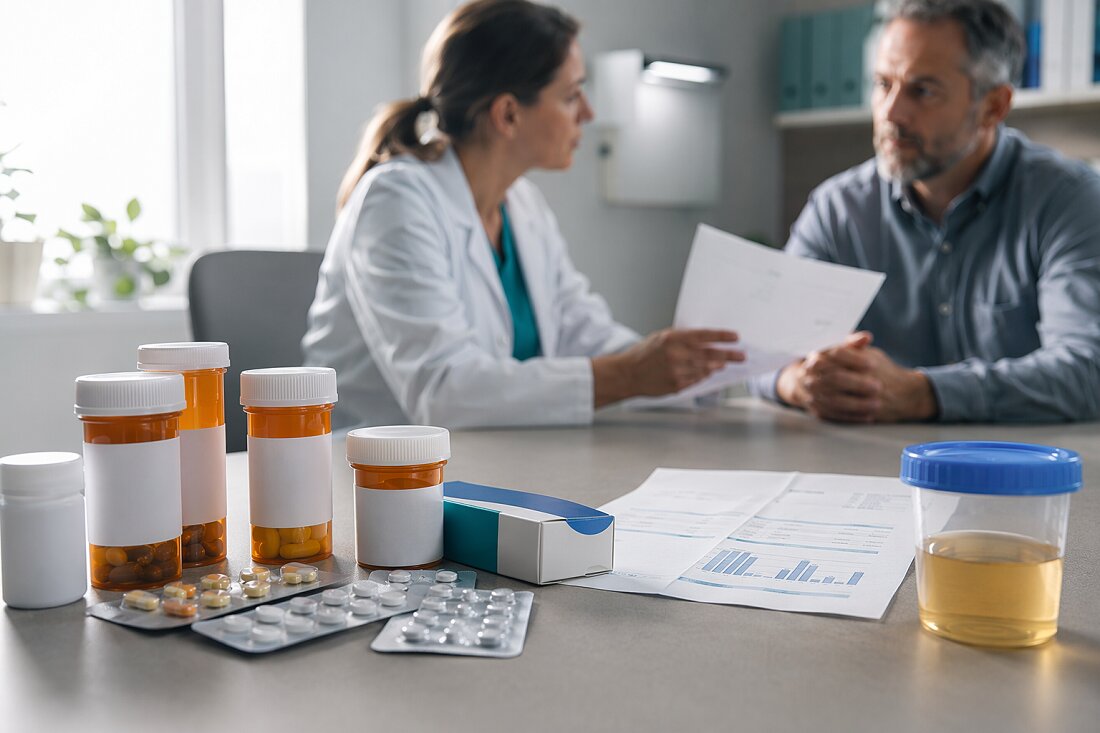
You might assume a drug test simply tells whether you’ve used a specific substance, but it’s not that straightforward. Many workplace and clinic tests rely on broad “screening” tools that can’t always distinguish your cold medicine, antidepressant, or heartburn pill from illicit drugs.
If you’re taking perfectly legal medications, you could still face unexpected results and what happens next depends on how the test is done, and what you do before it.
Common Medications That Cause False Positives
Although drug tests are designed to be accurate, a range of prescription and over‑the‑counter medications can cause false‑positive results and complicate interpretation. For example, some amphetamine‑type ADHD medications, certain decongestants containing pseudoephedrine, and a few antidepressants can lead to results that appear positive for amphetamines.
Consumption of foods containing poppy seeds may produce low‑level positive findings for opioids. Certain antibiotics, particularly rifampin, have been reported to interfere with some opiate assays.
Proton pump inhibitors and other acid‑reducing medications have occasionally been associated with false positives for THC or benzodiazepines in screening tests. Understanding the common false positive triggers for benzos in particular is useful, as several widely used medications, including some antihistamines, antidepressants like sertraline, and certain sleep aids, have been documented to cross-react with benzodiazepine immunoassays despite containing no benzodiazepine compounds. This makes benzodiazepine one of the more frequently misreported categories on standard screening panels.
Some antipsychotic medications, such as quetiapine, can cross‑react with assays used to detect methadone. In addition, common cold preparations and sleep aids may affect screening panels.
Because of these possibilities, it's important to inform the testing provider of all medications and supplements taken so that unexpected results can be evaluated and, when necessary, confirmed with more specific testing methods.
How Drug Tests Actually Work
Drug testing typically relies on well-established chemical and biochemical methods rather than opaque or unusual processes. Most routine screening tests use immunoassays, which are based on antibodies that recognize specific drugs or their metabolites in a sample.
In these tests, antibodies bind to target substances present in urine, saliva, blood, or hair, and the testing device converts that binding event into a detectable signal.
Results from initial screening tests are usually reported as positive or negative according to preset cutoff concentrations, not as exact quantitative values. When a screening test indicates a positive result, especially in legal, employment, or medical contexts, laboratories often use confirmatory methods such as gas chromatography-mass spectrometry (GC‑MS) or liquid chromatography-mass spectrometry (LC‑MS).
These techniques separate and identify compounds based on their characteristic chemical and mass spectral patterns, providing more specific and reliable identification than screening alone.
Why Medications Can Trigger False Positives
Drug tests often use antibody-based screening methods with preset cutoff levels, rather than identifying each substance by its exact chemical structure in the initial step.
These screening tests are designed to detect general “patterns” or chemical features associated with certain drugs.
Some medications have structures or metabolites that are similar enough to the target drug that the antibodies bind to them as well.
When this cross-reactivity occurs, and the detected level exceeds the established cutoff, the result may register as a positive, even though the person has only taken a legitimate medication.
This is why initial screening results are typically considered presumptive and are often followed by more specific confirmatory tests to accurately identify the substance involved.
What Increases Your Risk of a False Positive?
Several practical factors can increase the likelihood of a false positive on a drug test, even when medications are taken as prescribed. The risk is higher if you use multiple prescriptions at the same time, take higher doses, or have recently started, stopped, or changed medications.
Certain medical conditions, such as kidney or liver impairment, can slow the elimination of drugs and their metabolites, allowing them to remain detectable for longer periods.
Testing methods also play a role. Rapid immunoassay screens, especially when used without confirmatory testing, are more prone to cross‑reactivity and false positives.
The use of very low cut‑off levels increases sensitivity but can reduce specificity, making false positives more likely.
Additional contributors include cross‑reactivity in less specific test panels, laboratory handling or labeling errors, and incomplete or inaccurate reporting of all prescription, over‑the‑counter, and herbal products being used.
Everyday OTC Drugs That Affect Drug Tests
Even commonly used over‑the‑counter (OTC) products can interfere with certain drug screening methods, particularly older or less specific immunoassays. For example, some cold and allergy medications that contain pseudoephedrine or phenylephrine can be misidentified as amphetamines on initial screening tests.
Likewise, sleep aids and motion‑sickness products containing diphenhydramine may appear similar to sedating medications on some assays.
Some gastrointestinal medications have also been associated with false‑positive results. Ranitidine (when it was in common use) and, less consistently, high‑dose proton‑pump inhibitors have been reported to trigger positive screens for certain drug classes.
Dextromethorphan, an ingredient in many cough syrups, can sometimes produce results that resemble opioid or PCP use on preliminary tests.
Older testing methods occasionally showed interference from high doses of nonsteroidal anti‑inflammatory drugs (NSAIDs) such as ibuprofen or naproxen, leading to false positives for substances like marijuana or barbiturates.
Modern laboratory techniques and confirmatory tests have largely reduced these issues, but it remains important to report all OTC medications to the testing provider to aid in accurate interpretation.
Prescription Meds Most Likely to Affect Results
Prescription medications contribute to many complex or unexpected drug‑testing results. Opioid pain relievers, benzodiazepines used for anxiety or insomnia, and stimulant medications prescribed for ADHD can produce findings that resemble nonmedical use of similar substances.
In addition, certain antidepressants, antipsychotics, and anticonvulsants may lead to false‑positive results or complicate confirmatory testing.
Medications used to treat opioid use disorder (buprenorphine, methadone, and naltrexone) are frequently included in addiction‑focused screening panels and may be reported as positive findings even when taken as prescribed.
Other commonly used drugs, including some sleep aids, muscle relaxants, and migraine treatments, can also prompt additional review or clarification.
To reduce misinterpretation, patients should provide a complete list of current prescriptions before testing and have supporting documentation available.
This information helps clinicians and laboratories interpret results accurately and distinguish appropriate medical use from potential misuse.
How Different Drug Test Panels Handle Medications
Because each drug test panel targets a defined list of substances and specific cut‑off levels, the same medication can yield different outcomes depending on the test used. A standard 5‑panel test typically focuses on THC, cocaine, amphetamines, opiates, and PCP, so many prescription medications aren't assessed and therefore don't appear in the results. In contrast, expanded 10‑ or 12‑panel tests often include additional drug classes such as benzodiazepines, barbiturates, methadone, or propoxyphene.
When these substances are added, a medication that was irrelevant in a basic screen may become detectable and potentially reportable.
Laboratory‑based testing usually follows an initial immunoassay screen with confirmatory methods such as liquid chromatography-tandem mass spectrometry (LC‑MS/MS). These confirmatory tests are more specific and can distinguish prescribed medications from other substances in the same drug class.
By contrast, some rapid point‑of‑care test cups rely solely on the initial immunoassay, which increases the chance of false positives or ambiguous results.
Cut‑off concentrations also vary between tests and laboratories. A drug level that falls below the threshold in one panel may be reported as negative, while a different panel with a lower cut‑off could classify the same concentration as positive.
As a result, test selection, confirmation practices, and cut‑off values all influence how a particular medication appears in drug testing reports.
What To Do If Your Drug Test Seems Wrong
If your drug test result doesn't match your actual medication or substance use, approach the situation methodically.
Begin by obtaining a copy of the full laboratory report and identifying exactly which substance or drug class was reported as positive.
Ask whether the result is from an initial screening test only or if any confirmatory testing has already been performed.
If only a screening test was done, request confirmatory testing with a more specific method, such as gas chromatography-mass spectrometry (GC-MS) or liquid chromatography-mass spectrometry (LC-MS).
These techniques can usually differentiate between structurally similar substances and reduce the likelihood of false positives.
Inform the ordering clinician of all prescription medications, over-the-counter products, herbal supplements, and recent foods or beverages you have used, as many can interfere with screening tests.
Whenever possible, bring medication bottles, a written list, or photographs of labels.
If the test result may affect employment, legal status, or access to medical treatment, consider seeking advice from an attorney, union representative, or patient advocate.
They can help you understand applicable policies, deadlines, and procedures for disputing the result and ensure communication with employers, courts, or treatment programs follows established protocols.
How To Prevent Drug Test Mix-Ups (For Patients, Providers, and Employers)
From the time a drug test is ordered until the results are reviewed, clear communication and thorough documentation reduce the risk of mix‑ups.
Patients should provide a complete list of all prescription medications, over‑the‑counter drugs, and supplements, and, when possible, bring the original containers or clear photos of the labels.
Healthcare providers should document the indication for each medication, along with dosing and timing, and include this information with the test order.
They should confirm that the appropriate laboratory panel is selected and request confirmatory testing (such as GC‑MS or LC‑MS/MS) when initial results are unexpected or unclear.
Employers can limit errors by using certified laboratories, maintaining a clear written testing policy, and involving a qualified medical review officer.
Requiring photo identification at collection and enforcing strict chain‑of‑custody procedures for samples help ensure that results are correctly matched to the individual tested.
Conclusion
You don’t have to feel powerless around drug tests. When you know how they work, which meds can confuse them, and what raises your risk of a false positive, you’re better prepared. Always list your prescriptions and OTC drugs, ask about confirmatory testing if results don’t match your reality, and talk openly with your provider or employer. With a little planning, you can protect both your health and your reputation.